What Is Fat Transfer Breast Augmentation? Patient Education Guide
Updated May 2026

Patients researching fat transfer breast augmentation in Beverly Hills can use this guide as background and then review our comprehensive surgical page for candidacy, safety, and consultation planning.
What Is Fat Transfer Breast Augmentation?
Fat transfer breast augmentation — also called lipofilling, fat grafting, or autologous breast augmentation — is a surgical procedure that uses your own fat to increase breast volume. Rather than placing a synthetic implant inside the breast, a surgeon harvests fat from another part of your body, purifies it, and carefully injects it into the breasts to create a natural-looking enhancement.
At Aura Aesthetica in Beverly Hills, Dr. Jonathan Kanevsky specializes in this approach as a primary procedure for patients who want a subtle, implant-free result. The philosophy is simple: your own tissue integrates seamlessly, feels natural, and eliminates the long-term concerns that come with foreign materials. For more on fat grafting in Beverly Hills as a market specifically, see our city-focused guide.
How the Procedure Works
Fat transfer breast augmentation is a two-part procedure. The first step is liposuction — fat is removed from donor areas like the abdomen, flanks, inner thighs, or lower back using a small cannula. This fat is then processed and purified to isolate the viable fat cells before injection.
The second step is grafting. The purified fat is carefully injected into multiple layers of the breast tissue using small syringes, building volume gradually and evenly. The entire procedure typically takes two to three hours and is performed under general anesthesia.
Because the fat comes from your own body, there is no risk of rejection or allergic reaction. The results feel and move like natural breast tissue because, in essence, they are.
What Results Can You Expect?
Fat transfer breast augmentation is best suited for patients looking for a modest, natural-looking increase — typically one to one and a half cup sizes. It is not designed to produce the dramatic size change that large implants can achieve. What it does deliver is softness, proportion, and a look that is difficult to distinguish from natural breast tissue.
Some of the transferred fat will be reabsorbed by the body in the weeks following the procedure. Most surgeons anticipate a retention rate of roughly 60 to 70 percent, which is factored into how much fat is injected during surgery. Final results are typically visible at the three to six month mark once swelling has resolved and the surviving fat has stabilized. For a deeper look at the biology behind retention, see graft survival explained.
Who Is This Procedure For?
The ideal candidate for fat transfer breast augmentation is someone who wants a subtle, natural enhancement rather than a dramatic size increase; has adequate fat reserves in donor areas; wants to avoid the risks associated with breast implants; and is not a heavy smoker, as smoking impairs fat cell survival.
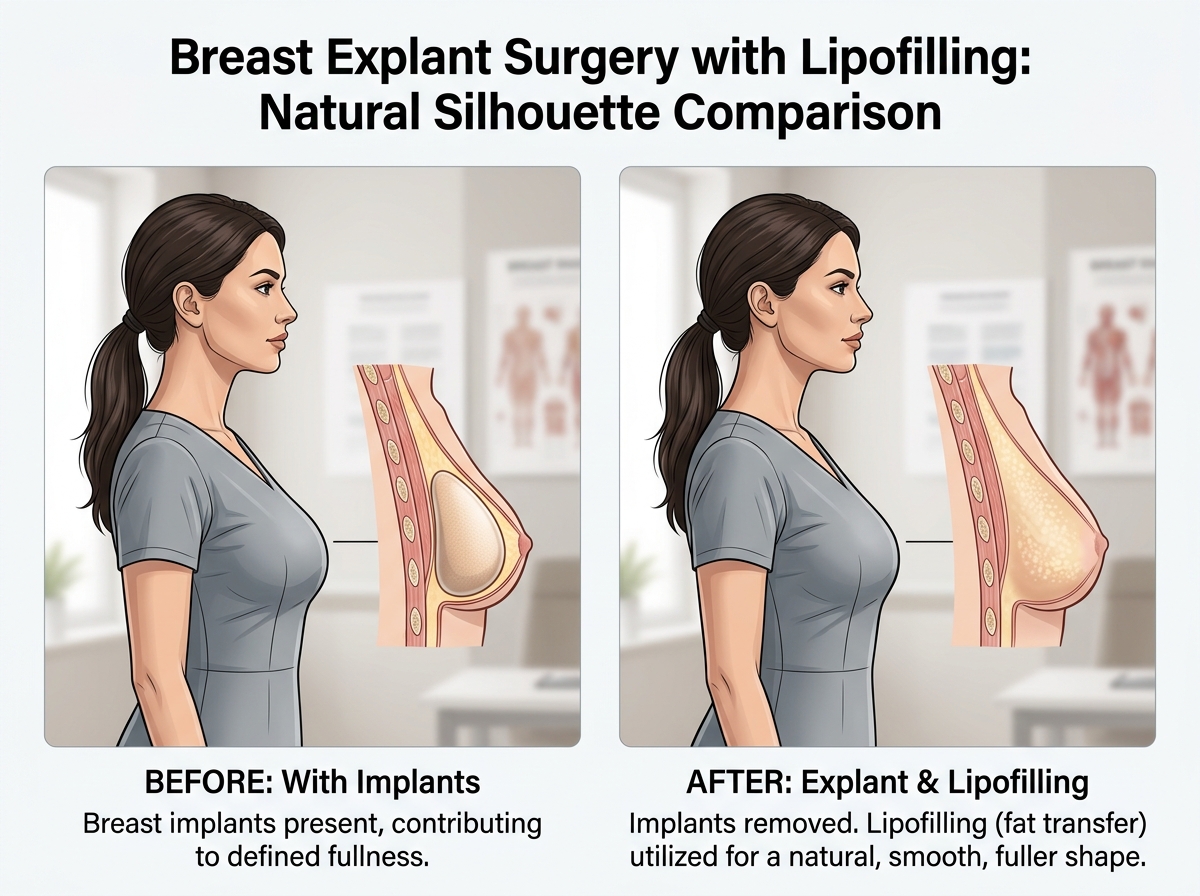
Patients who have previously had breast implants and want to go implant-free are also strong candidates, often combining explant surgery with fat grafting to restore volume without returning to synthetic materials.
Fat Transfer vs. Implants
The most common question patients ask is how fat transfer compares to traditional implants. The honest answer is that they serve different goals. Implants can produce a larger, more defined result and are appropriate for patients wanting more than one cup size increase. Fat transfer produces a softer, more natural result with the added benefit of body contouring at the donor site — and no foreign material inside the body.
For a deeper comparison, see our guide on fat transfer vs breast implants.
Keep Reading
Learn how fat transfer compares in our guide to fat transfer vs breast implants, find out whether you are a good candidate, or explore why patients choose Dr. Kanevsky as their fat transfer breast surgeon in Los Angeles.
Schedule a Consultation in Beverly Hills
If you are exploring implant-free breast enhancement, Dr. Kanevsky at Aura Aesthetica offers personalized consultations to help you understand whether fat transfer is the right approach for your anatomy and goals. Call us at 310-773-4596 or request a consultation online.
Medically reviewed content
Reviewed by Dr. Jonathan Kanevsky
This educational article was reviewed by Dr. Jonathan Kanevsky, a board-certified plastic surgeon in Beverly Hills specializing in fat transfer procedures, body contouring, breast surgery, and recovery-focused aesthetic planning.
Last updated: May 2026
Related articles
Continue reading: Fat Transfer Breast Augmentation
2026-04-29
Fat Transfer Breast Augmentation Guide 2026 | Beverly Hills
Complete Beverly Hills guide to fat transfer breast augmentation: candidacy, cost, recovery, risks, results, fat survival, and how to choose a specialist.

2026-04-22
Fat Transfer vs Breast Implants: Which Is Right for You?
Fat transfer vs breast implants — which is right for you? See how size, feel, recovery, and long-term risk compare from an implant-free surgical specialist.

2026-04-22
How Long Do Fat Transfer Breast Augmentation Results Last?
How long do fat transfer breast augmentation results last? See why surviving fat is permanent, what affects it, and how the 60-70% retention rate is calculated.
2026-06-04
Non-Surgical Breast Lift in Beverly Hills: What Are Your Options?
Learn the most effective non-surgical breast lift options in Beverly Hills, including fat transfer, skin tightening, and breast rejuvenation treatments.
Related reading
Explore next steps for breast fat grafting
- fat transfer breast augmentation Beverly Hills
- breast fat grafting Beverly Hills
- fat grafting breast augmentation
- natural breast augmentation
- breast augmentation with fat transfer
- Beverly Hills cost planning
- Recovery milestones after fat transfer to the breasts
Ready for individualized recommendations? Request your consultation for a personalized treatment plan.