Why Fat Is Reabsorbed After Breast Augmentation — And How to Maximize Graft Survival
Updated May 2026
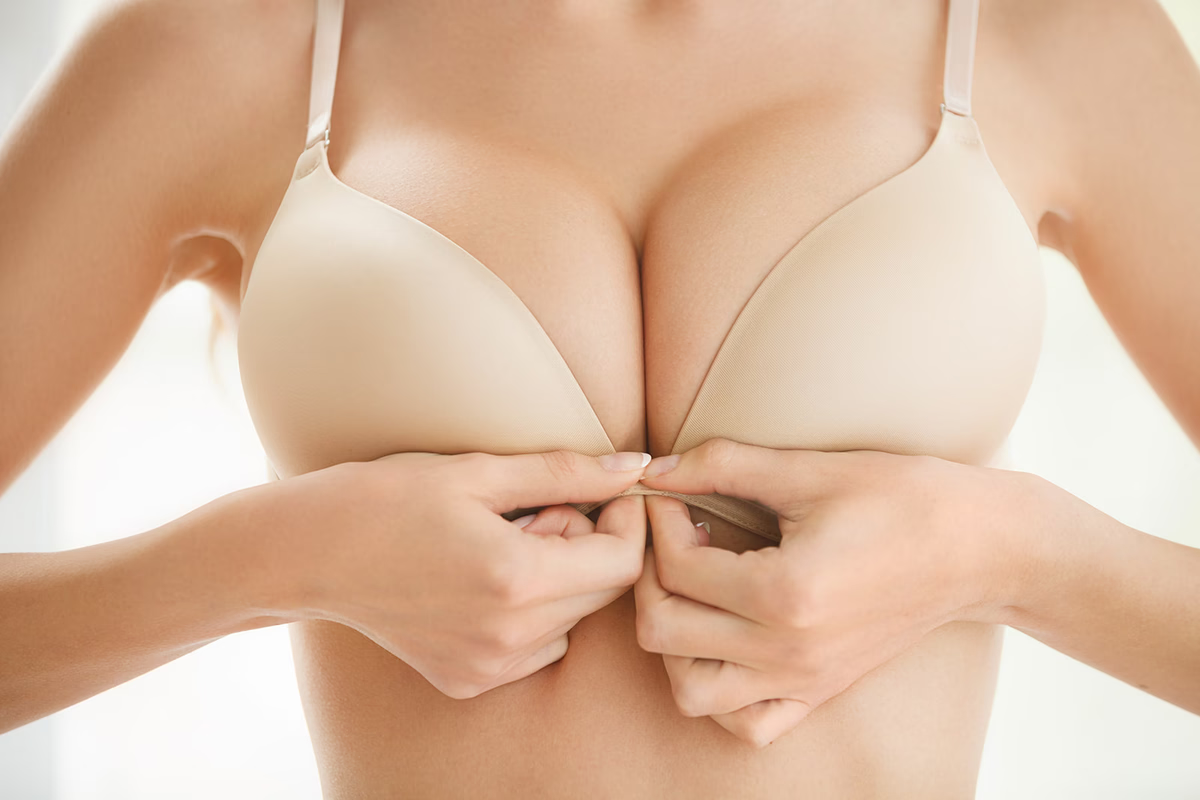
Patients researching fat transfer breast augmentation in Beverly Hills can use this guide as background and then review our comprehensive surgical page for candidacy, safety, and consultation planning.
The Question Every Patient Asks
"If I do fat transfer, how much of the fat actually stays?" It is the single most common question patients ask during a consultation for fat transfer breast augmentation — and it deserves a direct, honest, clinically accurate answer. The reality is that a percentage of transferred fat is always reabsorbed by the body in the weeks and months after surgery. That is not a complication. It is not a failure of technique. It is basic biology — and understanding it is the key to having realistic expectations, choosing the right surgeon, and maximizing the volume that survives long-term. (For the broader procedure overview, see the complete guide to fat transfer breast augmentation.)
At Aura Aesthetica in Beverly Hills, Dr. Jonathan Kanevsky has built his fat transfer practice around a single technical principle: the fat you inject is not the fat you keep. Every decision in surgery — how fat is harvested, processed, and injected — is made with one goal in mind, which is to maximize the percentage of transferred fat cells that successfully establish a blood supply and become permanent living tissue. This article explains the science behind that process, the factors that affect it, and what patients can do to give their results the best possible chance.
What Actually Happens to Transferred Fat
When fat is harvested from a donor site and injected into the breast, the individual fat cells are temporarily cut off from their blood supply. Each cell needs oxygen and nutrients to survive, and it has only a narrow window — roughly three to five days — to establish a new connection to the surrounding blood vessels through a process called neovascularization. Cells that successfully make this connection survive and become permanent. Cells that do not are recognized by the body as non-viable tissue and reabsorbed through normal cellular cleanup processes.
This window is the critical period of fat grafting. Everything that determines your final result — how much volume you keep, how soft and natural it feels, how long it lasts — is determined in the first week after surgery. After that, the fat that survived has become part of your living tissue and will behave like any other fat in your body: gaining and losing weight with you, aging with you, and staying with you for the rest of your life.
The Expected Survival Range
The published literature on fat transfer breast augmentation generally reports fat survival rates in the range of fifty to eighty percent. That is a wide range for a reason: the actual survival number depends heavily on the surgeon's technique and the individual patient's biology. A well-performed fat transfer with modern technique typically retains sixty to seventy percent of the injected volume. An older technique using bulk injection into a poorly vascularized recipient site might retain only thirty to forty percent. A meticulously performed procedure with ideal patient factors can retain close to eighty percent.
This is why experienced surgeons always inject more fat than the patient ultimately wants to keep. The overcorrection is planned from the start and calibrated to the expected survival rate for that patient. If the goal is a final volume increase of 250cc per breast, the surgeon might transfer 375cc to account for expected resorption.
Why the First Three to Six Months Matter Most
Most fat resorption occurs in the first three months after surgery. By six months, the final result is almost fully established. After six months, the surviving fat cells are permanent and will remain for the rest of the patient's life — gaining volume if the patient gains weight, losing volume if the patient loses weight, but otherwise stable.
This has two practical implications. First, patients should not evaluate their results before six months. The breasts at one month look different from the breasts at three months, which look different from the breasts at six months. Swelling has to resolve and the non-viable fat has to be cleared before the real outcome is visible. Second, any secondary procedures — touch-ups, small revisions, or additional fat transfer to correct asymmetry — should be delayed until the six-month mark so the surgeon can assess a stable baseline.
Surgical Factors That Affect Fat Survival
The single biggest variable in fat graft survival is the surgeon's technique. Three specific technical factors account for most of the variation in outcomes — which is why what to look for in a fat transfer specialist is so much about technical refinement and not just credentials.
Harvest technique. Fat cells are more fragile than they look. Aggressive liposuction using high vacuum pressure or aggressive cannula movement damages a significant percentage of cells before they ever reach the breast. Modern fat transfer uses low-pressure harvesting with specialized cannulas designed to preserve cell viability. The difference in viable cells between a gentle harvest and an aggressive one can easily be twenty percent or more.
Processing technique. After harvest, the aspirated fluid contains a mixture of fat cells, blood, anesthetic solution, oil from ruptured cells, and tissue debris. Only the intact, viable fat cells should be injected. Several processing methods exist — decantation, centrifugation, washing, and filtration — and they are not equivalent. Closed sterile processing systems that separate viable fat from non-viable components without exposing the tissue to air or contamination consistently produce better survival outcomes than older open techniques.
Injection technique. This is where modern fat transfer diverges most dramatically from older approaches. The principle is simple: each fat cell must be within diffusion distance of a blood vessel to survive the first few days. If fat is injected in large clumps, the cells in the center of the clump cannot get oxygen and die, creating fat necrosis. If fat is injected in thin, spread-out ribbons — the technique known as micro-transfer or micro-fat grafting — every cell is close to a blood vessel and survival rates are dramatically higher.
A surgeon performing a 300cc micro-transfer might make several hundred individual passes through the breast, laying down tiny amounts of fat in multiple tissue layers. It is slower, more technically demanding work than bulk injection, but the survival rate difference justifies every extra minute.
Patient Factors That Affect Fat Survival
Not all of fat survival is under the surgeon's control. Several patient factors significantly affect outcomes and should be addressed — when possible — before surgery.
Smoking. Nicotine constricts small blood vessels and impairs the neovascularization process that newly grafted fat cells depend on. Smokers consistently have lower fat survival rates than non-smokers, and in some practices, active smoking is a contraindication to fat transfer entirely. Patients who stop smoking at least four to six weeks before surgery and remain nicotine-free through recovery dramatically improve their outcomes. For a deeper look, see our guide on why smoking is a major risk factor for aesthetic surgery complications.
Body fat percentage and weight stability. Patients with adequate donor fat and stable weight generally have better outcomes. Very lean patients sometimes do not have enough harvestable fat to achieve their goal volume in a single procedure. Patients who lose significant weight in the year after surgery will also lose breast volume proportionally, because the surviving fat cells shrink along with the rest of the body's fat.
Compression and activity during recovery. The first two weeks after surgery are critical for graft take. Excessive movement, pressure on the breasts, or sleeping on the stomach can physically disrupt the fragile new blood vessel connections forming around each fat cell. Following the surgeon's postoperative instructions precisely — including wearing the prescribed compression garment, avoiding strenuous activity, and sleeping on the back — has a measurable effect on the final survival percentage.
Age and vascular health. Younger patients with healthier microvascular circulation tend to establish new blood vessel connections faster than older patients. This is not typically a reason to decline surgery, but it does factor into expected outcomes.
Why Some Patients Need a Second Session
For patients who want a larger volume increase than can be safely achieved in a single procedure — or whose donor fat reserves are limited — a staged approach using two sessions often produces better results than trying to transfer a large volume at once. The reason is straightforward: there is a physical limit to how much fat can be safely injected into the breast at one time. Injecting too much overwhelms the available blood supply, which increases the resorption rate and the risk of fat necrosis. It is almost always better to transfer a moderate volume with high survival than a large volume with poor survival.
A second session is typically performed four to six months after the first, once results have stabilized. The first session's surviving fat has established its own blood supply and expanded the tissue envelope, making the second session even more successful. For patients seeking two cup sizes or more of volume increase, the staged approach is often the only safe way to achieve their goal with fat transfer alone.
The Permanence of Surviving Fat
Once the initial resorption phase is complete at six months, the surviving fat is permanent. It is not a temporary filler. It is not something that dissolves over time. The cells that survived are now part of your body's natural fat distribution, and they will behave like any other fat in your body for the rest of your life.
This is the most important difference between fat transfer and other volumizing procedures. Hyaluronic acid fillers gradually dissolve and require repeated treatments. Implants remain foreign material indefinitely and may require replacement. Fat transfer, once it has taken, is your own living tissue — and it stays.
For more detail on what long-term fat transfer results look like year over year, see our full guide on how long fat transfer breast augmentation results last.
How Dr. Kanevsky Maximizes Graft Survival
Every decision in Dr. Kanevsky's fat transfer technique is built around maximizing survival. Fat is harvested from multiple donor sites in balanced amounts using low-pressure technique with fine cannulas that preserve cell viability. The harvested tissue is processed in a closed sterile system that separates viable fat from non-viable components without exposing the cells to air or mechanical stress. Injection is performed as micro-transfer — hundreds of small passes distributing fat in thin ribbons across multiple tissue layers of the breast.
Patient selection is also part of the technique. Patients who are not good candidates — because of inadequate donor fat, unstable weight, active smoking, or unrealistic expectations — are identified in consultation and either guided toward a better-suited procedure or declined. The survival rates at Aura Aesthetica consistently fall at the upper end of the published range because every variable, from the first incision to the final compression garment, is optimized for it. For the broader picture of what fat grafting in Beverly Hills involves — from procedure technique to patient sophistication — see our market-specific guide.
Setting Realistic Expectations
The patients who are happiest with their fat transfer results are the ones who understood the process before surgery. They knew that the breasts would look larger immediately and then gradually settle into their final size over three to six months. They knew that sixty to seventy percent of what was transferred would become permanent. They knew that their result would be natural and proportionate rather than dramatic. They followed their recovery instructions carefully and gave their body the best possible chance to hold onto what was transferred.
If you are considering fat transfer breast augmentation, the most important thing you can do is have a frank conversation with your surgeon about what fat survival means for your specific case. Ask what percentage retention they typically see in their practice. Ask how they process the fat. Ask how they define a successful result. The answers will tell you far more than marketing photos ever could. Patients who want that conversation with Dr. Kanevsky can schedule a consultation at Aura Aesthetica.
Keep Reading
Explore whether fat transfer is right for you in our guide to who makes a good candidate, understand every stage of healing in our week-by-week recovery guide, or see how the procedure compares to implants in our fat transfer vs breast implants comparison. For recovery-supportive options, read how red light therapy after fat transfer may support healing, or visit the main fat transfer breast augmentation procedure page.
Medically reviewed content
Reviewed by Dr. Jonathan Kanevsky
This educational article was reviewed by Dr. Jonathan Kanevsky, a board-certified plastic surgeon in Beverly Hills specializing in fat transfer procedures, body contouring, breast surgery, and recovery-focused aesthetic planning.
Last updated: May 2026
Related articles
Continue reading: Fat Transfer Breast Augmentation
2026-04-29
Fat Transfer Breast Augmentation Guide 2026 | Beverly Hills
Complete Beverly Hills guide to fat transfer breast augmentation: candidacy, cost, recovery, risks, results, fat survival, and how to choose a specialist.

2026-04-22
What Is Fat Transfer Breast Augmentation? Patient Education Guide
What is fat transfer breast augmentation? Your own fat is harvested, purified, and injected to grow breast volume naturally — no implants. See the basics here.

2026-04-22
Fat Transfer vs Breast Implants: Which Is Right for You?
Fat transfer vs breast implants — which is right for you? See how size, feel, recovery, and long-term risk compare from an implant-free surgical specialist.

2026-04-22
How Long Do Fat Transfer Breast Augmentation Results Last?
How long do fat transfer breast augmentation results last? See why surviving fat is permanent, what affects it, and how the 60-70% retention rate is calculated.
Related reading
Explore next steps for breast fat grafting
- fat transfer breast augmentation Beverly Hills
- breast fat grafting Beverly Hills
- fat grafting breast augmentation
- natural breast augmentation
- breast augmentation with fat transfer
- Beverly Hills cost planning
- Recovery milestones after fat transfer to the breasts
Ready for individualized recommendations? Request your consultation for a personalized treatment plan.