What Is Nipple Inversion Surgery -- and Is It Right for You?
Updated May 2026
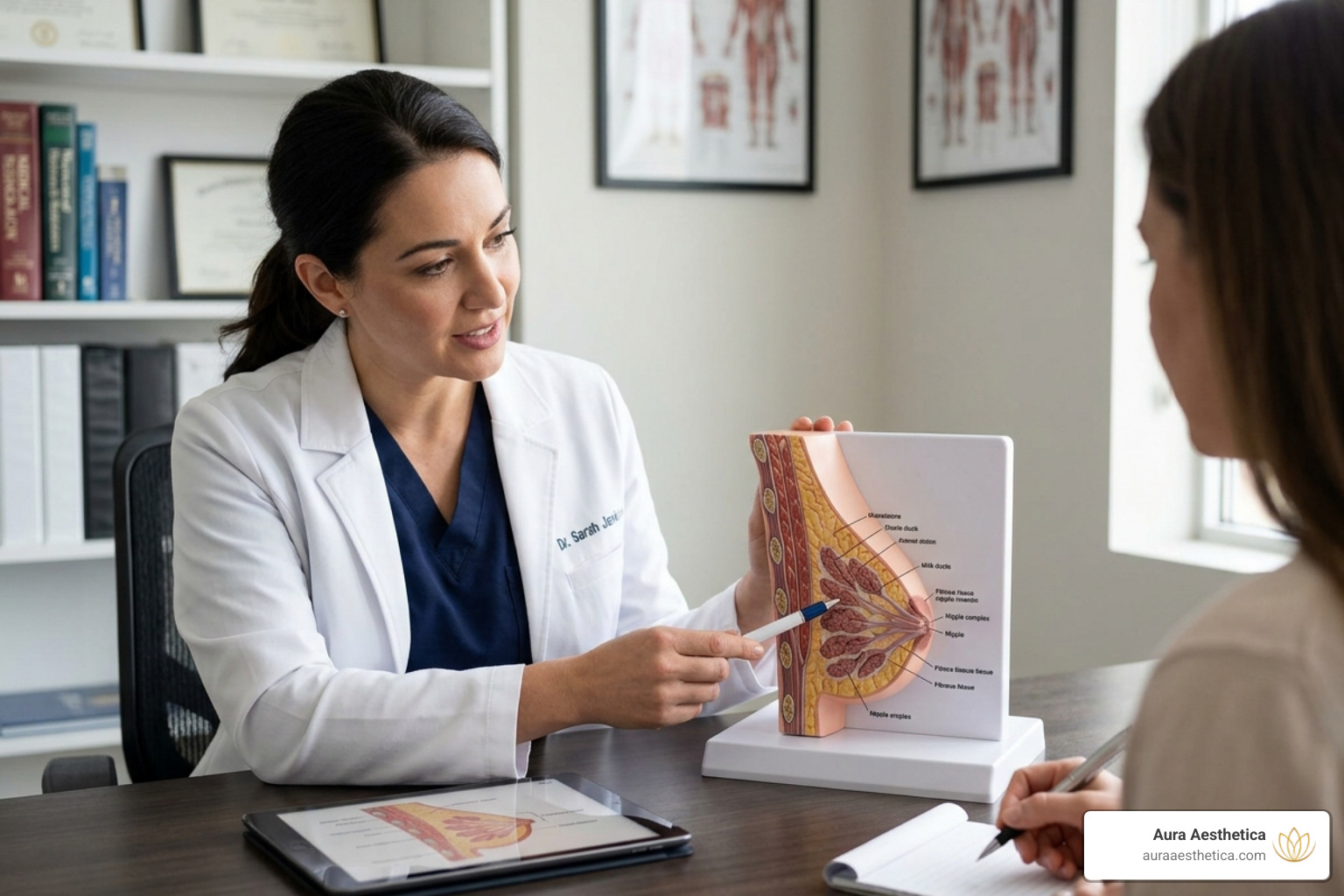
What Is Nipple Inversion Surgery -- and Is It Right for You?
Nipple inversion surgery is a minimally invasive outpatient procedure that corrects nipples that point inward instead of outward.
- What it treats: Nipples that retract inward due to tight or shortened milk ducts
- Who it is for: Anyone with Grade 1, 2, or 3 nipple inversion bothered by the appearance or function
- How it works: A small incision at the nipple base releases the tethering tissue; sutures hold the nipple in a natural outward position
- Anesthesia: Local anesthesia in most cases -- no general anesthesia needed
- Procedure time: 30 to 60 minutes
- Recovery: Return to light activity within 1 to 2 days; full recovery in 4 to 6 weeks
- Success rate: 85 to 95% with modern surgical techniques
- Breastfeeding: Duct-preserving techniques retain breastfeeding ability in roughly 80 to 85% of cases
Inverted nipples are far more common than most people realize. Research estimates they affect 10 to 20% of women -- yet it remains one of the least talked-about aesthetic concerns. For many women, the condition quietly affects confidence, clothing choices, and intimacy. Others notice it only causes difficulty with breastfeeding. Either way, the feelings it brings up are real -- and so are the options to address it.
I am Dr. Jonathan Kanevsky, a board-certified plastic and reconstructive surgeon trained at McGill University and USC, with clinical expertise in breast surgery including nipple inversion surgery. My approach combines surgical precision with a commitment to natural, proportionate results -- so you feel like yourself, only more confident.
Understanding Nipple Inversion: Grades and Causes
To understand why nipple inversion surgery is performed, we first need to look at the why and how of the condition itself. Nipple inversion occurs when the small milk ducts (lactiferous ducts) and surrounding connective tissues are too short or tight, acting like a tether that pulls the nipple inward toward the breast tissue.
The Three Grades of Inversion
- Grade 1 (Shy Nipples): These nipples are mostly flat or slightly inverted but can be easily pulled out manually or through stimulation. They tend to stay out for a while before retracting. Breastfeeding is usually unaffected in Grade 1 cases.
- Grade 2 (Moderate Inversion): These nipples are more consistently retracted. While they can be pulled out with some effort, they retract almost immediately once released. There is more significant fibrosis (scar-like tissue) present than in Grade 1.
- Grade 3 (Severe Retraction): These nipples are deeply inverted and cannot be pulled out manually. The milk ducts are very short, and there is significant constriction. This grade often presents functional challenges, such as difficulty with hygiene or breastfeeding.
Why Does This Happen?
For the majority of the 10 to 20% of women affected, the cause is congenital, meaning you were simply born with shorter milk ducts or a lack of supportive tissue under the nipple. However, inversion can also be acquired later in life due to inflammation (conditions like mastitis or mammary duct ectasia), trauma (previous breast surgeries or physical injury), or aging (natural sagging or mammary involution can sometimes pull the nipple inward).
A Critical Note on Sudden Inversion: If you notice a nipple that was previously outward-pointing has suddenly become inverted, you must seek a medical evaluation immediately. While most cases are cosmetic, a sudden change can occasionally be a sign of an underlying medical issue, such as a tumor or infection.
| Characteristic | Grade 1 | Grade 2 | Grade 3 |
|---|---|---|---|
| Ease of Eversion | Very Easy | Difficult | Impossible |
| Duration of Projection | Maintains for a while | Retracts immediately | Does not project |
| Fibrosis/Tethering | Minimal | Moderate | Severe |
| Breastfeeding Impact | Usually none | Possible difficulty | High difficulty |
Advanced Techniques in Nipple Inversion Surgery
At Aura Aesthetica, we view nipple inversion surgery through our Surgery as Ceremony lens -- a process that is as much about restoring your body harmony as it is about technical correction. Depending on your anatomy and whether you plan to breastfeed in the future, we utilize several advanced techniques.
Duct-Preserving vs. Duct-Dividing
The primary choice in nipple inversion surgery is whether to keep the milk ducts intact.
- Duct-Preserving: This is the gold standard for women who wish to maintain the ability to breastfeed. We use microsurgical techniques to release the tight fibrous bands around the ducts without severing the ducts themselves.
- Duct-Dividing: In severe Grade 3 cases, or for patients who are finished with childbearing, we may need to divide the shortened ducts to achieve a permanent, tension-free projection.
Specialized Surgical Methods
Modern plastic surgery has moved far beyond simple pull and stitch methods. We look to minimally invasive techniques to ensure the smallest possible scars and the most natural results.
- The Parachute Technique: This involves placing internal purse-string sutures that act like the strings of a parachute, providing constant upward support to the nipple.
- Double Triangle Suture: A newer method where two small 2mm incisions are used to place non-absorbable sutures in a triangle pattern. This technique is excellent for preserving the central lactiferous ducts while providing durable projection.
- Dermal Flaps: In complex cases, we may create a small internal scaffold using your own dermal tissue to prevent the nipple from ever sinking back in.
For more detailed information on how we customize these steps, you can explore our inverted nipples procedure page.
Preparing for Nipple Inversion Surgery
The first step is a consultation at one of our California locations (Beverly Hills, Los Angeles, or Orange County). We will review your medical history and assess your inversion grade. Because this is a minor procedure, it is almost always performed as an outpatient surgery under local anesthesia. This means you are awake but completely numb in the treatment area. The entire process typically takes only 30 to 60 minutes, and you can drive yourself home afterward.
Risks and Success Rates
Generally, nipple inversion surgery has a success rate of 85 to 95%. However, like any surgery, there are risks to consider:
- Recurrence: There is a small risk (roughly 2 to 9%) that the nipple may partially retract over time, especially in severe Grade 3 cases.
- Sensation Changes: While most patients retain full sensitivity, some may experience temporary numbness or, rarely, a permanent decrease in sensation.
- Infection: This is rare, but we provide prophylactic care and strict aftercare instructions to minimize this risk.
Recovery and Long-Term Aftercare
One of the best things about nipple inversion surgery is how quickly you can return to your life. Most of our patients in Southern California find they can return to work within 1 to 2 days.
The Healing Timeline
- Days 1 to 2: You may feel some mild soreness or throbbing, which is easily managed with over-the-counter Tylenol or Ibuprofen.
- Week 1: Initial swelling and any minor bruising will begin to fade. If we used non-dissolvable sutures, they are typically removed after 7 days.
- Weeks 2 to 4: You should avoid strenuous upper-body exercise or heavy lifting.
- Week 6: The danger zone for retraction has passed, and your results are considered stable.
Post-Op Restrictions and Tips
- No Compressive Bras: Avoid sports bras or underwires for the first 2 weeks. We want zero downward pressure on the nipples.
- Protective Dressings: We may provide foam doughnuts or small protective caps to wear inside your bra to prevent the nipple from being flattened.
- Keep it Clean: Gently wash the area with warm water and mild soap starting 24 to 48 hours after surgery.
Impact on Breastfeeding and Functional Outcomes
A major concern for many of our younger patients is whether they can still breastfeed after nipple inversion surgery. The answer is: in the vast majority of cases, yes. When we use duct-preserving techniques, approximately 80 to 85% of women retain their ability to lactate and breastfeed. In fact, for some women with Grade 3 inversion, the surgery actually improves their chances of breastfeeding because it allows the baby to achieve a proper latch on the nipple-areolar complex.
However, if your inversion is severe and requires a full release of the lactiferous ducts, breastfeeding may no longer be possible. We always discuss your future family planning in detail during your consultation to ensure we choose the technique that aligns with your life goals.
Frequently Asked Questions
How much does the procedure cost and is it covered by insurance?
In the United States, particularly in areas like Beverly Hills and Orange County, the price for nipple inversion surgery typically ranges from $2,000 to $4,000. This price can vary depending on whether you are treating one nipple or both, and if you are combining the procedure with other enhancements like a breast lift or augmentation. Because this is almost always classified as a cosmetic procedure, insurance rarely covers it. However, we offer various financing options to make this transformative change accessible.
Are the results of the correction permanent?
Yes, for the vast majority of patients, the results are permanent. Once the internal tether is released and the tissue heals in an everted position, the nipple stays out. That said, significant hormonal changes (like pregnancy) or extreme weight fluctuations can occasionally impact the breast tissue and lead to a recurrence.
What non-surgical treatments are available?
If you have Grade 1 inversion, you might find some success with non-surgical options: the Hoffman Technique (a series of manual exercises where you pull the areola in opposite directions to stretch the internal adhesions), suction devices like the Niplette (which use a small vacuum to pull the nipple out over several weeks), or nipple piercings (though this is not a medical correction and carries its own risks of infection). While these can work for very mild cases, they rarely provide a permanent solution for Grade 2 or 3 inversion. Surgical correction remains the most reliable way to achieve a lasting result.
Conclusion
At Aura Aesthetica, we believe that every procedure -- no matter how small -- is an opportunity for a Surgery as Ceremony experience. Correcting inverted nipples is not just about the physical change; it is about the confidence that comes from feeling normal in your own skin and no longer having to worry about how you look in a swimsuit or during intimate moments.
Whether you are in Beverly Hills, Los Angeles, or Orange County, our team is dedicated to providing you with natural-looking, scarless results in a warm and supportive environment. If you are ready to take the next step toward feeling more like yourself, we invite you to schedule a consultation for inverted nipples with us today. Let us bring your inner confidence to the surface.
For more information about nipple inversion surgery, please schedule a consultation with Dr. Jonathan Kanevsky at his Beverly Hills plastic surgery clinic. To book, call 310-773-4596.
Medically reviewed content
Reviewed by Dr. Jonathan Kanevsky
This educational article was reviewed by Dr. Jonathan Kanevsky, a board-certified plastic surgeon in Beverly Hills specializing in fat transfer procedures, body contouring, breast surgery, and recovery-focused aesthetic planning.
Last updated: May 2026
Related articles
Continue reading: Scarless Breast Lift & Breast Procedures

2026-04-22
What Is Fat Transfer Breast Augmentation? Patient Education Guide
What is fat transfer breast augmentation? Your own fat is harvested, purified, and injected to grow breast volume naturally — no implants. See the basics here.

2026-04-22
Fat Transfer vs Breast Implants: Which Is Right for You?
Fat transfer vs breast implants — which is right for you? See how size, feel, recovery, and long-term risk compare from an implant-free surgical specialist.

2026-06-19
Hybrid Breast Augmentation: Fat Transfer and Implants
Hybrid breast augmentation combines a breast implant with fat transfer for softer edges, improved cleavage, and more natural contour in selected Beverly Hills and Los Angeles patients.
2026-06-04
Non-Surgical Breast Lift in Beverly Hills: What Are Your Options?
Learn the most effective non-surgical breast lift options in Beverly Hills, including fat transfer, skin tightening, and breast rejuvenation treatments.