What Lipofilling Breast Before and After Really Looks Like
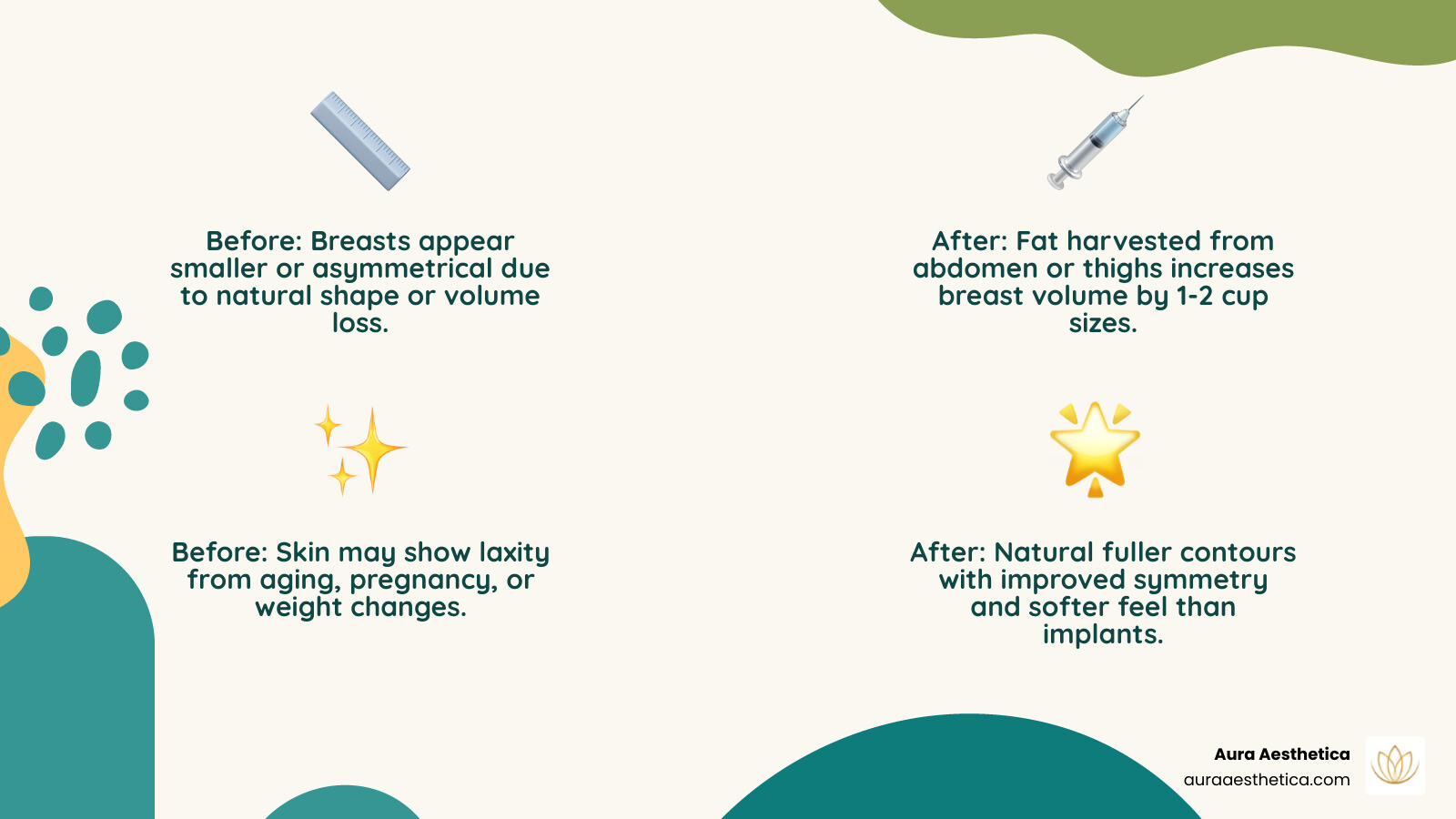
What Lipofilling Breast Before and After Really Looks Like
Lipofilling breast before and after results show a natural increase in breast volume -- typically up to one full cup size -- using your own fat, with no implants and minimal scarring.
| What You Want to Know | The Short Answer |
|---|---|
| Volume increase | Up to 1 cup size per round of sessions |
| Fat retention rate | ~58% on average (range: 14-119%) |
| Sessions needed | Median of 4 (range: 2-6) |
| Recovery time | 4-7 days downtime; final results at 3 months |
| Scarring | Minimal -- tiny cannula entry points only |
| Implants needed? | No -- uses your own harvested fat |
| Affects cancer screening? | No increased risk; findings are benign and distinguishable |
I am Jonathan Kanevsky, MD, FRCSC, a board-certified plastic and reconstructive surgeon trained at McGill University with a USC cosmetic surgery fellowship.
What to Expect from Results
Most patients can expect a modest but meaningful increase in volume. Clinical data suggests that a single session typically results in an enlargement of about one cup size. Research indicates a median fat retention rate of approximately 58% after a follow-up of about two years. While 30% to 50% of the transplanted fat may be broken down by the body within the first 6 weeks to 3 months, the fat that remains after the six-month mark is generally considered permanent.
Aesthetic Refinements
- Cleavage Definition: We can strategically place fat in the medial (inner) part of the breast to create a closer, more defined cleavage.
- Lower Pole Expansion: For breasts that feel empty at the bottom, fat grafting can round out the lower curve.
- Natural Feel: Because we are using autologous tissue (your own cells), the breasts remain soft to the touch, with no risk of capsular contracture.
The Procedure: How Fat Becomes Breast Volume
Step 1: Harvesting
The procedure begins with specialized liposuction targeting donor sites like the abdomen, flanks, or thighs. This provides a dual benefit -- we slim down a trouble area while gathering the material needed for the breasts.
Step 2: Purification and Processing
Once harvested, the fat cannot be injected immediately. We use advanced fat grafting techniques such as centrifugation or specialized filtration to isolate the pure, concentrated fat cells.
Step 3: The Art of Injection
We do not just dump the fat into the breast. Instead, we use a 3D scaffolding technique. By injecting the fat in thousands of tiny micro-droplets across multiple layers, we ensure each droplet has access to a blood supply. Importantly, we avoid injecting fat directly into the breast gland itself.
Ideal Candidates and Recovery
The ideal candidate for breast fat grafting has sufficient donor fat, realistic expectations (0.5 to 1 cup size increase per session), and a stable weight.
Recovery Timeline
- Days 1 to 3: Soreness similar to a heavy workout. Most discomfort comes from the liposuction donor site.
- Days 4 to 7: Most patients return to desk work wearing a compression garment on the donor area.
- Weeks 2 to 6: Swelling in the breasts begins to subside during the resorption phase.
- Month 3: Results are largely settled and you can see the final volume.
Safety, Risks, and Long-Term Maintenance
- Fat Resorption: Expect to lose about 30 to 50% of the initial volume. We often slightly overfill during surgery to compensate.
- Oil Cysts: Small pockets of fat that did not survive can turn into oil cysts in about 7% of cases. Most are harmless.
- Calcifications: Over time, some non-surviving fat can form tiny calcium deposits that are benign but can show up on imaging.
Fat transfer does not hide cancer on a mammogram. Experienced radiologists can easily distinguish between fat necrosis and suspicious lesions. It does not increase your risk of developing breast cancer. Once the fat has survived past the 6-month mark, it is there to stay -- stable results have been seen at the 2-year and 5-year marks.
Frequently Asked Questions
How many sessions are required for final results?
While some patients are happy after one round, achieving a significant volume increase often requires a median of 4 sessions, typically spaced about 3 months apart.
Does fat transfer affect breast cancer screening?
No. While it can cause benign calcifications or focal enhancements on an MRI, these are well-documented and easily identified by radiologists.
What is the average cost of the procedure?
The price varies based on the number of donor sites, the volume of fat being transferred, the number of sessions required, and anesthesia and facility fees. Because it involves two surgeries in one (liposuction plus breast injection), it is often more expensive than a simple implant augmentation, but many find the two-for-one body contouring and natural results worth the investment.
Conclusion
At Aura Aesthetica, we believe that surgery should be more than just a physical change -- it should be a Surgery as Ceremony. Lipofilling breast before and after results offer a bridge between wanting more and wanting to stay natural. If you are ready to see what your own liquid gold can do for your silhouette, book a consultation for breast fat grafting with us in Beverly Hills or Los Angeles.