When Breast Implants Cause Pain: What You Need to Know About Explant Surgery for Capsular Contracture
When Breast Implants Cause Pain: What You Need to Know About Explant Surgery for Capsular Contracture
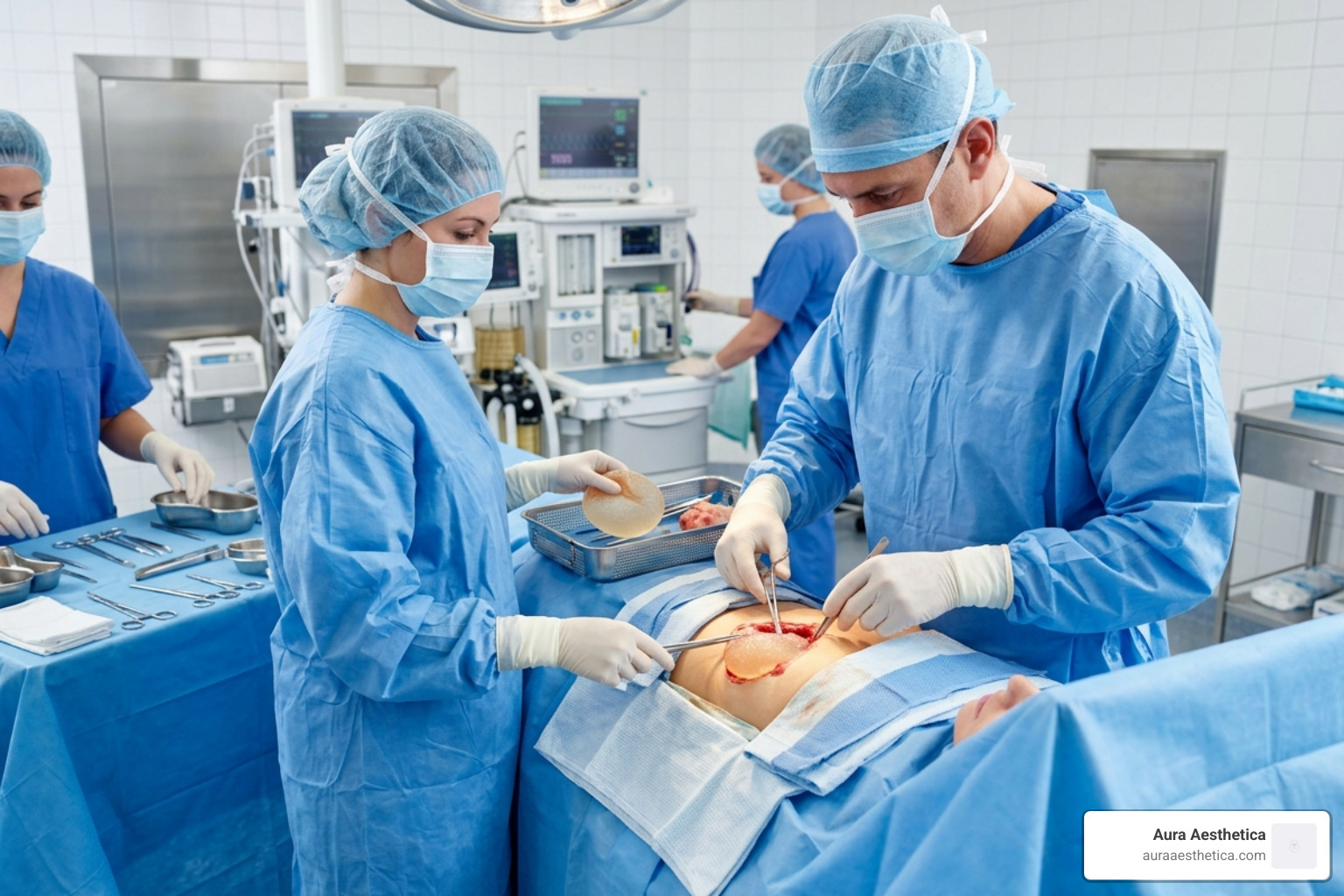
Explant surgery for capsular contracture is a procedure that removes breast implants -- and the hardened scar tissue surrounding them -- to relieve pain, restore natural breast shape, and improve quality of life.
| What You Want to Know | The Short Answer |
|---|---|
| What is it? | Surgical removal of breast implants plus the scar capsule around them |
| Who needs it? | Women with Grade III or IV capsular contracture causing pain, hardness, or distortion |
| Types of surgery | En bloc capsulectomy, total capsulectomy, or partial capsulectomy |
| Recovery time | Typically 2-6 weeks |
| Does insurance cover it? | Sometimes, if medically necessary (e.g., severe contracture or rupture) |
| Will breasts look deflated? | Possibly -- a breast lift or fat transfer can restore shape |
Breast implants are not lifetime devices. Over time, the body forms a natural layer of scar tissue -- called a capsule -- around any implant. For most women, this is harmless. But for some, that tissue thickens and tightens into what doctors call capsular contracture, causing chronic pain, visible distortion, and real distress.
Capsular contracture is the leading reason for revision surgery after breast augmentation, accounting for nearly 50,000 reoperations every year in the United States alone.
I am Dr. Jonathan Kanevsky, MD, FRCSC, a board-certified plastic and reconstructive surgeon trained at McGill University with advanced cosmetic surgery fellowship training at USC. I have performed and studied explant surgery for capsular contracture extensively, and in this guide I will walk you through everything you need to make a confident, informed decision.
Understanding Capsular Contracture and Breast Implants
When we place a breast implant, your body does exactly what it is supposed to do: it identifies a foreign object and creates a protective barrier of scar tissue around it. This is called the capsule. In a perfect world, this capsule remains thin, soft, and flexible.
However, in about 15% to 30% of cases, the body healing response goes into overdrive. This results in capsular contracture, where the scar tissue becomes abnormally thick and begins to squeeze the implant. Imagine wearing a pair of shoes two sizes too small -- that constant, crushing pressure is what your implant (and your chest wall) feels.
The Baker Scale: How We Measure Severity
Surgeons use the Baker Scale to determine how advanced the contracture is. This helps us decide if explant surgery for capsular contracture is medically necessary.
| Baker Grade | Clinical Symptoms | Appearance |
|---|---|---|
| Grade I | Breast is soft and looks natural. | Normal. |
| Grade II | Breast is slightly firm but looks normal. | Normal. |
| Grade III | Breast is firm and looks distorted or shifted. | Visible distortion (round or hard look). |
| Grade IV | Breast is hard, cold, distorted, and painful. | Severe distortion and physical discomfort. |
Why Does This Happen?
- Biofilm Theory: Research suggests that low-grade bacteria can form a microscopic film on the implant. This biofilm keeps the immune system in a state of chronic inflammation, leading to thick scar tissue.
- Implant Rupture: If a silicone implant leaks, the silent rupture can irritate the surrounding tissue, causing it to harden.
- Hematoma or Seroma: If blood or fluid trapped around the implant during the initial surgery was not fully absorbed, it can trigger intense scarring.
Symptoms of a Contracted Implant
- Increased Firmness: One or both breasts feel unnaturally hard to the touch.
- Shape Distortion: The breast may look balled up, too high on the chest, or unnaturally round.
- Chronic Pain: A dull ache, sharp shooting pains, or a constant tight sensation.
- Restricted Movement: You might feel like your chest muscles are tight, making certain exercises or stretches uncomfortable.
- Aesthetic Dissatisfaction: The breasts no longer look like the results you originally paid for.
Choosing Explant Surgery for Capsular Contracture
Deciding to remove your implants is a deeply personal journey. At Aura Aesthetica, we view explant surgery for capsular contracture not just as a medical fix, but as Surgery as Ceremony -- a chance to return your body to its natural state and find relief from years of physical burden.
When Is Explant Surgery Recommended?
While Grade I and II contractures can often be monitored or treated with non-surgical methods like massage or certain medications, explant surgery for capsular contracture is typically the gold standard for Grade III and IV cases. We often recommend surgery when pain is persistent and interferes with daily life or sleep, when a previous capsulotomy was performed and the hardness returned, when the patient is experiencing Breast Implant Illness (BII) symptoms, or when the patient has aging implants that are beyond their recommended lifespan.
Surgical Techniques: Capsulectomy and Removal
When we perform explant surgery for capsular contracture, our goal is complete removal of the problem. Simply taking out the implant is not enough; we must address the scar capsule. The procedure is performed under general anesthesia and typically takes 1 to 3 hours. We strive to use your original incision sites (usually in the breast fold) to avoid creating new scars.
The En Bloc Approach
En bloc is a French term meaning as a whole. In an en bloc capsulectomy, the surgeon removes the implant and the entire scar capsule together as one single, unopened unit.
Why is this the gold standard?
- Containment: If the implant is ruptured, the en bloc technique ensures no silicone or debris leaks into your body.
- Biofilm Elimination: By removing the capsule intact, we ensure that any bacteria or inflammatory markers are removed completely.
- Precision: It requires a high level of surgical skill to peel the capsule away from the chest wall and ribs without tearing the tissue.
Total vs. Partial Capsulectomy
- Total Capsulectomy: We remove 100% of the scar tissue. This is the most effective way to prevent the contracture from coming back if you choose to replace the implants.
- Partial Capsulectomy: If the scar tissue is dangerously adhered to the ribs or the lining of the lungs (the pleura), we may leave a small piece behind to avoid a pneumothorax (collapsed lung). Safety always comes first.
After removal, we often send the capsule tissue to a pathology lab. This allows us to check for hidden infections, silicone migration, or rare cells associated with BIA-ALCL.
Recovery and Aesthetic Results After Explant
The Healing Timeline
- Days 1 to 3: You will feel some tightness and soreness. We provide personalized pain management and may use drainage tubes to prevent fluid buildup (these are usually removed within a week).
- Week 1: Most patients can return to light desk work. You will wear a surgical support bra 24/7.
- Weeks 2 to 3: Swelling begins to subside. You can resume light walking but should avoid heavy lifting.
- Weeks 4 to 6: Most patients are cleared for full exercise and can see their new natural shape emerging.
Restoring Shape with Lift and Fat Transfer
One of the biggest fears women have is the deflated look. After years of carrying implants, the skin and breast tissue have often stretched. To address this, we offer holistic reconstruction options:
- Breast Lift (Mastopexy): We remove excess skin and reposition the nipple to a more youthful, perky height.
- Fat Transfer (Lipofilling): Using our specialized Aura Fill technique, we take fat from areas like the thighs or abdomen via liposuction and carefully inject it into the breast. This provides a soft, natural volume boost without the need for a foreign object.
- Auto-Augmentation: For some patients, we can use their own internal breast tissue to create a natural-looking mound.
Frequently Asked Questions
Does health insurance cover explant surgery for capsular contracture?
Under the Women Health and Cancer Rights Act (WHCRA), insurance must cover explantation and reconstruction if the implants were part of a post-mastectomy reconstruction. For cosmetic implants, coverage is harder to get but not impossible. Many providers will cover explant surgery for capsular contracture if we can prove medical necessity -- this usually requires documentation of severe pain (Baker Grade IV), confirmed implant rupture via MRI or ultrasound, or functional impairment.
How effective is explant surgery at preventing recurrence?
If you choose to replace your implants after a capsulectomy, there is always a risk of the contracture returning. However, we use several best practice techniques to minimize this: moving the implant from over the muscle to under the muscle (or vice versa), using a triple antibiotic wash to kill any potential biofilm, and using an acellular dermal matrix (ADM) to provide a clean, soft environment for the new implant. If you choose to leave the implants out permanently, the recurrence of contracture is impossible because the trigger (the implant) is gone.
What is the link between BII and capsular contracture?
While Breast Implant Illness (BII) is not yet a formal medical diagnosis, thousands of women report systemic relief after explantation. Many women with BII also have some degree of capsular contracture. The theory is that the hardened capsule acts as a reservoir for chronic inflammation. By performing a total or en bloc capsulectomy, we remove the source of this immune system red alert, which often leads to a significant improvement in patient-reported outcomes like energy levels and joint health.
Conclusion
Living with the tightness of capsular contracture can feel like a constant weight on your chest -- both physically and emotionally. Explant surgery for capsular contracture offers a path back to comfort, health, and a body that feels like yours again.
At Aura Aesthetica, we do not just perform surgery; we facilitate a transformation. Whether you are in Los Angeles, Beverly Hills, or Orange County, our Surgery as Ceremony approach ensures that your journey toward natural beauty and holistic healing is supported every step of the way.
If you are ready to let go of the pain and rediscover your natural self, we invite you to schedule a consultation for En Bloc Capsulectomy with our expert team today. Your body deserves to feel light, soft, and free.